

Architecture of Memory

Curators
Manar and Sharifah Alhinai
Exhibition Opening Date
September 2021
About the Artist
Dana Al Rashid is a Kuwaiti visual artist, architect who specializes in the historic building preservation and restoration. and journalist from Kuwait. She writes regularly for Al Jarida Newspaper, as well as various independent publications, including Sekka. Merging her interdisciplinary skills into one, she often illustrates her own articles and poetry.
Al Rashid’s art has been featured in a variety of virtual and in person galleries, such as the Holy Art Gallery in the United Kingdom, previous Khaleeji Art Museum exhibitions and shows, as well as local galleries in Kuwait. Her works have also been featured in international publications such as Art and Object, Routledge Press, as well as Vogue and Cosmopolitan.
Al Rashid continues to write and paint on a regular basis, further refining and developing her signature digital miniature art style, drawing inspiration from that which is ancient while addressing relevant contemporary topics.
September 2021
A solo exhibition by Kuwaiti artist Dana Al Rashid
Kuwaiti artist and architect Dana Al Rashid uses her artistic practice as a form of cultural resistance, raising a visual voice against the ongoing demolition of historic buildings in Kuwait in favor of modern concrete developments. Trained in the preservation of historical architecture, Al Rashid draws from her professional knowledge and deep cultural roots to highlight the value of Kuwait’s modern heritage.
Inspired by the Islamic miniature tradition—historically known as “the art of the book”—Al Rashid reinterprets this intricate style to reflect contemporary themes. Each piece resembles a page from a storybook, blending documentation with imagination. Time-traveling figures from Ottoman, Abbasid, and Safavid eras appear alongside contemporary activists, reclaiming a shared space of memory, resistance, and belonging.
Though created digitally, Al Rashid’s works are meticulously hand-drawn using a tablet pen, maintaining the integrity of traditional techniques. She introduces pixel art to frame her miniatures with modernized mosaic borders and embeds poetic Arabic text in saja, a form of rhymed prose historically used in manuscript art.
These works also serve as powerful tools of architectural documentation. Some depict specific buildings threatened or lost to demolition, often including portraits of those who fought to save them. In doing so, they raise questions about what qualifies as heritage—especially in a young country like Kuwait. According to Kuwait’s monument laws, a building can be considered as having historic value if it has a lifespan of 40+ years. Younger buildings can also be considered according to a variety of factors, such as the uniqueness of architectural style, as well as the significance of events surrounding the building, among other criteria that can precisely determine its value and status.
Kuwait experienced an economic and cultural boom beginning in the 1950s, which transformed it to a modern country. International architects from all over the world were commissioned to create iconic landmarks that would reflect this monumental shift into the modern world, such as the Kuwait Towers and the Kuwait Water Towers, which are also featured in the artworks in order to mark this national story of transformation. However, unlike these towers, there are many other architectural jewels have either already been demolished, or are under the threat of being wiped out at any instance, which shows the downside of continuous modern transformation.
Displayed chronologically by construction date, the works invite visitors to take a nostalgic journey through Kuwait’s architectural evolution. Through this exhibition, Al Rashid aims to spark awareness and protect the tangible memories that help define a nation’s soul.
Traces of Al Khidr
Dana Al Rashid
2020
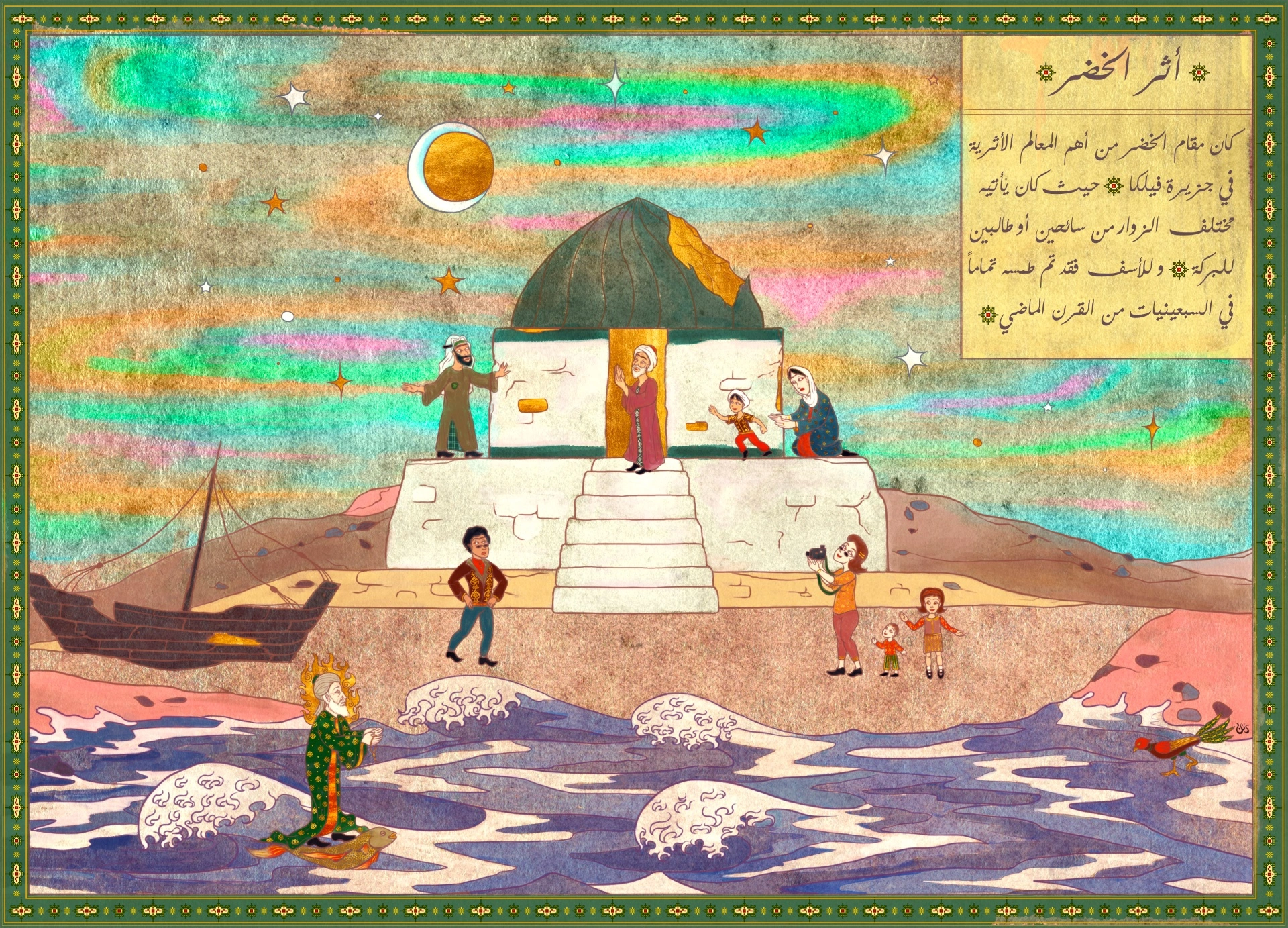
This work depicts the Al Khidr Structure, which was located on Failaka Island, and was visited by people for blessings and to perform religious rituals. It was demolished by the authorities in the 1930s, but later rebuilt by devoted people using stones that had survived the demolishment. However, it was demolished once more in 1976, this time permanently. This work depicts the Al Khidr Structure in its original form, before its demolition, surrounded by locals and visitors. Al Rashid reconstructed it in this work after referring to old photographs. The colors of the sky evoke the air of spirituality associated with the structure, while the golden interior of the structure symbolizes the hidden essence of things, which may not be apparent to people at first glance, as was the case in the story of Al Khidr. The work expresses the importance of preserving historical structures in all their forms, and of respecting everyone’s freedom of religious expression.
Saving Al Husainan’s House
Dana Al Rashid
2021

This work depicts another example of the architecture of government built houses, but this house boasts more traditional elements in its architecture.
The Al Husainan Home, which was built in the 1950s in Al Fayha, was under the threat of demolition when the descendants of the late homeowner, Abdulrahman Al Husainan, wanted to demolish and rebuild the house. However, thanks to the efforts of activists and architecture and culture enthusiasts, the demolition and reconstruction plans were eventually suspended. The house is also in the process of being enlisted in the country’s list of buildings of architectural and historical value to ensure its protection. Nowadays, many photographers and traditional architecture enthusiasts visit the home to document it.
This work was drawn in a technical drawing style, while also maintaining the overall miniature art style (albeit with a degree of three dimensionality). The work was also brightened by the addition of green trees at the bottom left to contrast the darkness of the grey asphalt. The frame of the work was inspired by the wallpaper design that decorates the interiors of the Al Husainan House to add an intimate, personal touch.
Abdullah Salih Al Hamily’s House
Dana Al Rashid
2020
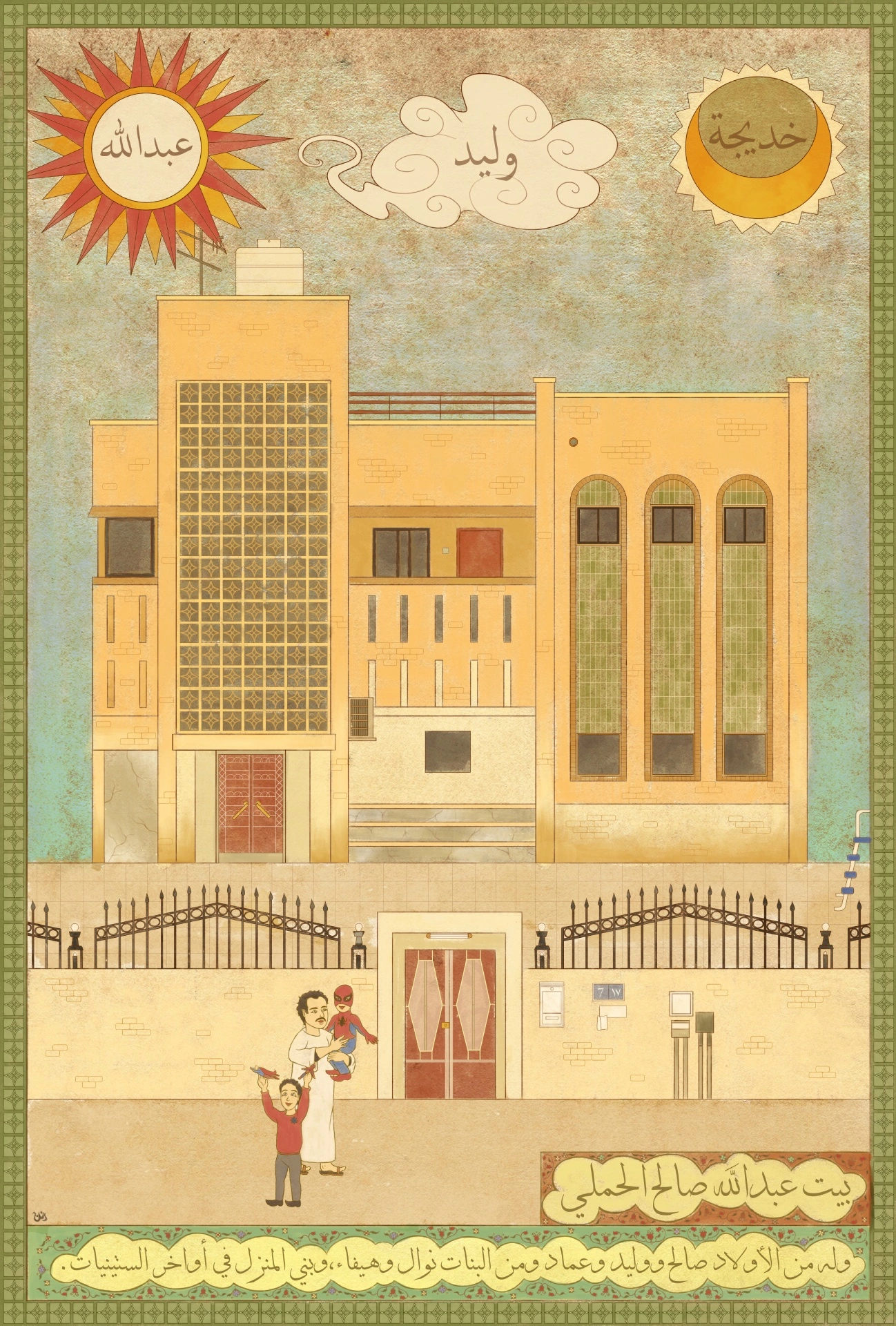
This work documents a model of Kuwaiti houses that have stood out due to their architectural designs that blend modern elements with Kuwaiti heritage. For example, traditional elements, such as the courtyard and mashrabiya, have been redefined to maintain the traditional architectural spirit. These model homes began to appear in Kuwait’s Golden Age (from the 1950s to the 1980s).
This work was commissioned by Ahmed Al Hamily in order to document his previous house before its demolition, as it was regrettably sold so that another house would be built in its place. The house was drawn using old photographs of it as references, and it captures the spirit of the house and its occupants. The names of the late elders of the family are written in the sky. Vintage shades of brown, yellow. and green were used to evoke nostalgia and take us back in time. In addition to its historical and cultural value, the house also has a sentimental human value in the memories of those of who dwelled in it, which makes the house a great example of the architecture of memory and the genius loci of a place.
Kuwait and Sweden: Parallel Worlds
Dana Al Rashid
2020
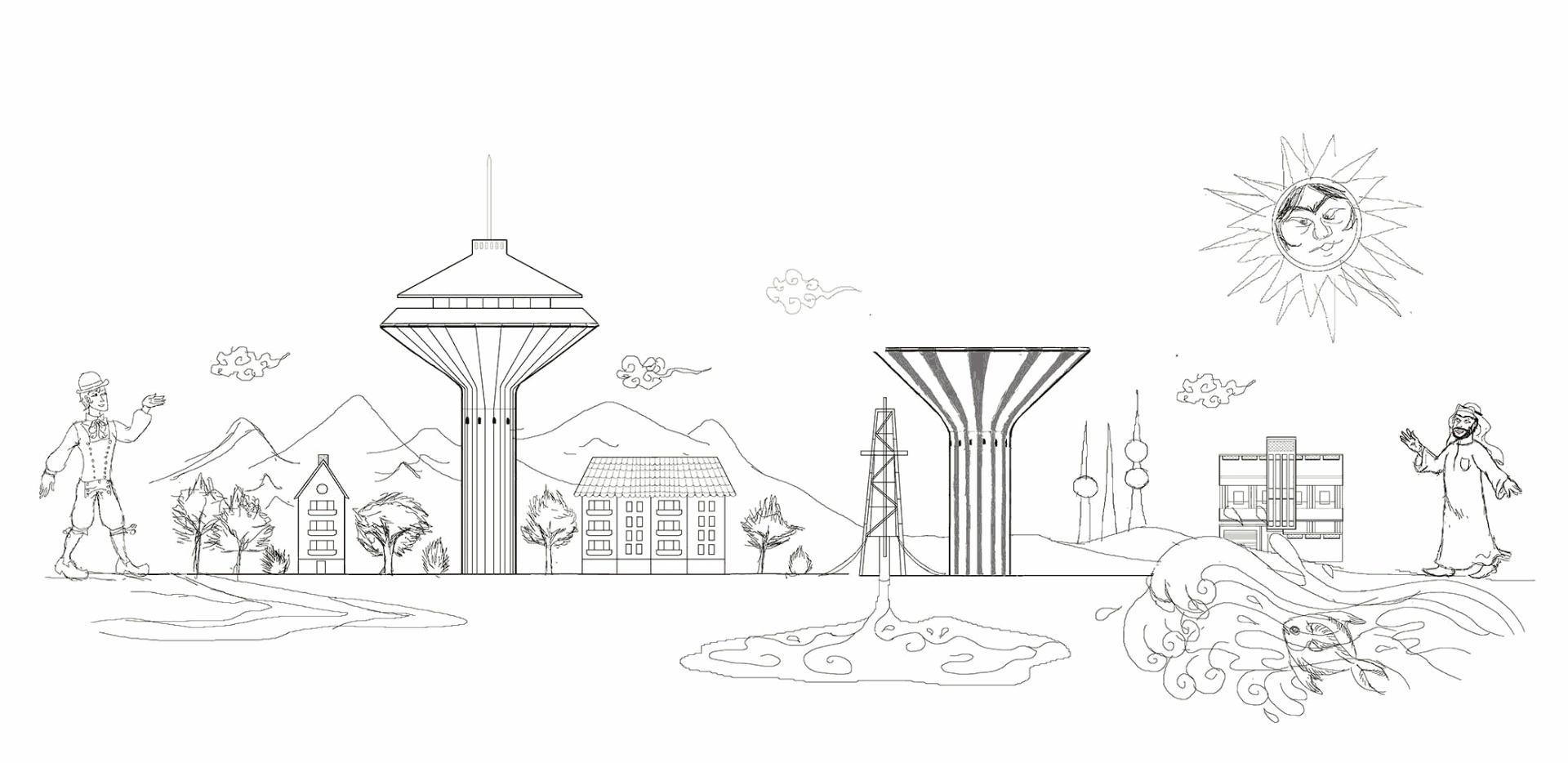
The Kuwait Water Towers were designed by Swedish architect Suni Lindström, who also designed Sweden’s equivalent of the water towers, The Mushroom, which is located in the city of Örebro. While The Mushroom was designed in 1958 and is 58 meters tall, the Kuwait Water Towers were built in 1976, and are 35 meters in height. The work expresses the strong diplomatic ties between Sweden and Kuwait, despite the vast differences in their cultures and environments. It showcases Kuwait’s openness to the different cultures of the world throughout its urbanization and modernization period, which is known as its Golden Age.
In this work, viewers can also see the Kuwait Towers-the “older brother” of the Kuwait Water Towers- in the background, as well as examples of the uniquely designed government houses in Kuwait. In addition, viewers can also see cultural and natural elements that both countries are known for, as well as citizens of each country dressed in their traditional attire.
Visualization of the Water Tower Construction Steps
Dana Al Rashid
2020
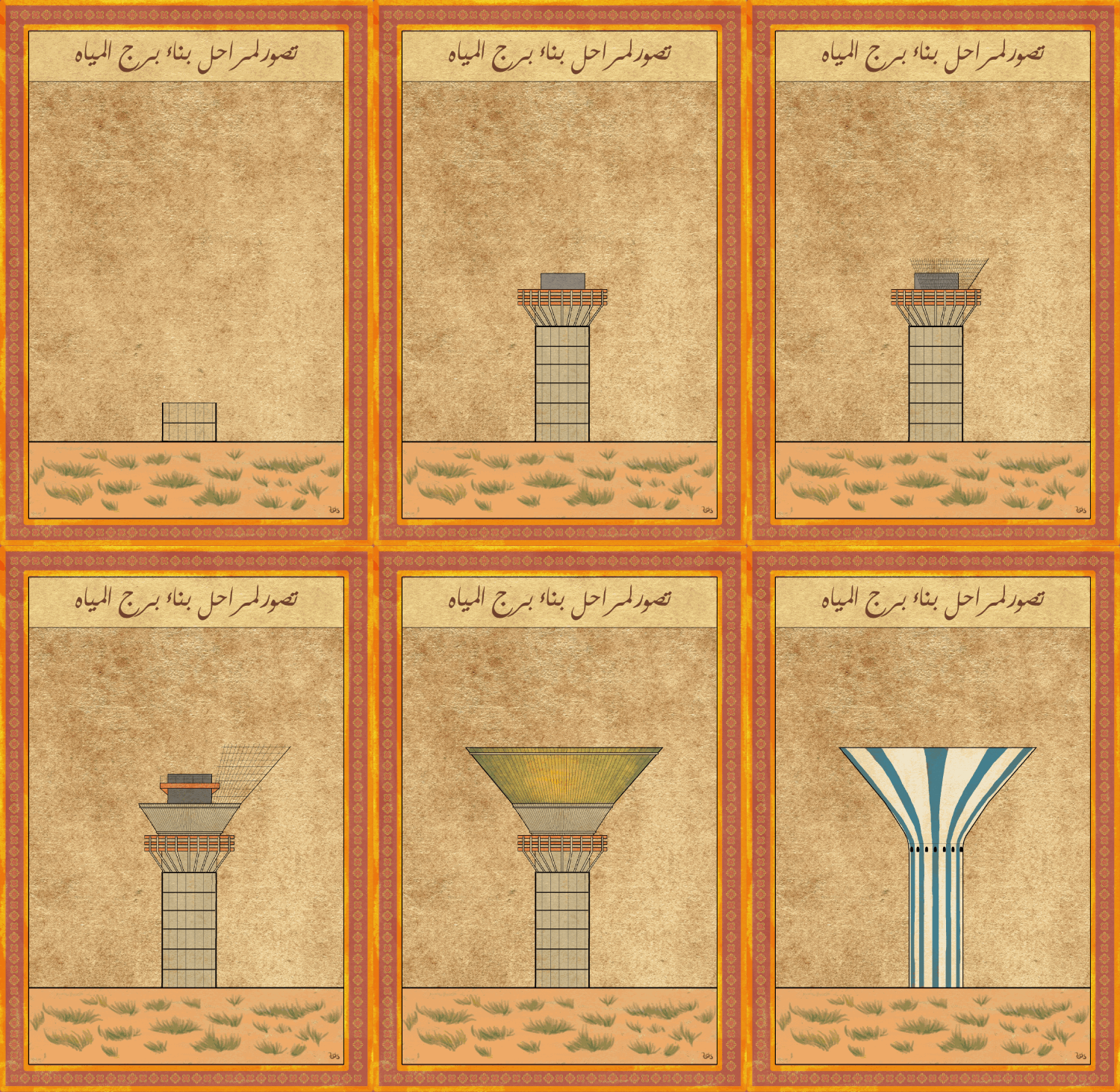
Using several historic photographs, Al Rashid created this animation that depicts the stages of the construction of the Kuwait Water Towers. The animation aims to shed light on the beauty of the raw, initial stages of the towers’ construction, exposing the towers’ skeletal structure and its unrefined “truth” – for lack of a better term. It’s as if the viewer is seeing an x-ray of the towers.
The Water Towers
Dana Al Rashid
2020

Whenever Kuwait is mentioned, the Kuwait Water Towers-including the iconic Kuwait Towers, which are depicted in another work in this exhibition- are amongst the first images that come to one’s mind. The Kuwait Water Towers were designed by Swedish architect Sune Lindström , with 31 water towers in total located in several areas in clusters of five. Their flared tops provide shade to landscaped public areas beneath—such as those at Al‑Adailiya Park. In 1980, the entire system of water towers—including the complementary Kuwait Towers—was honored with the Aga Khan Award for Architecture.
The work is the first of a series of four artworks that depict the Kuwait Water Towers. Al Rashid focused on the towers due to their importance as an architectural language and identity that Kuwait has been known for. The work showcases the duality of the parched land and its replenishment, as it blends the sea blue hues of the towers with brown, arid shades of the desert and the lush green of the trees below, forming an oasis that breathes life into the harsh weather and environment of Kuwait.
Water System Map
Dana Al Rashid
2020
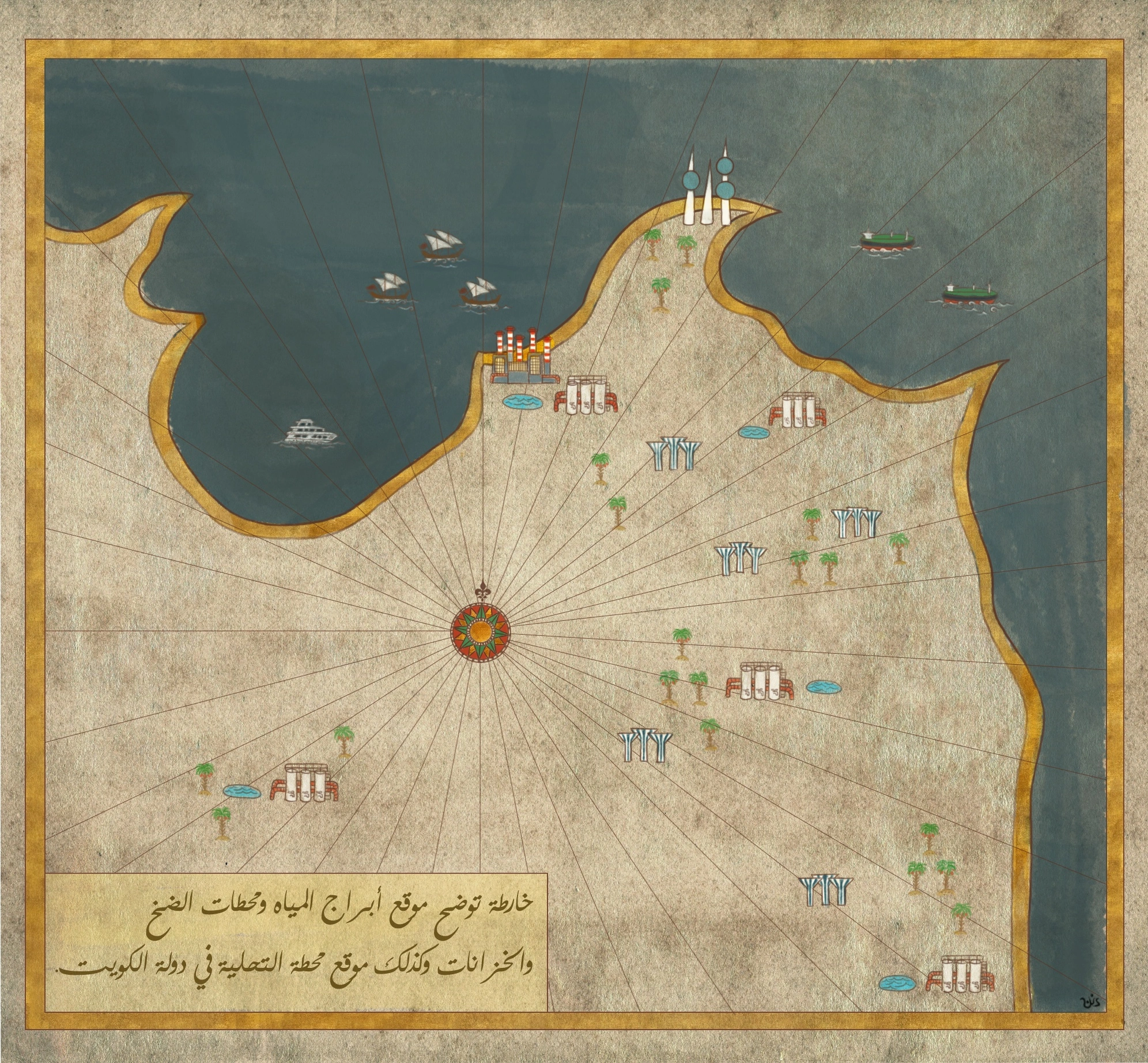
This work is a map that clarifies the location of the Kuwait Water Towers and the pump stations and storage units, as well as the location of the water desalination station in Kuwait. It is a work through which viewers can understand the remainder of the works exhibited about the Kuwait Water Towers, and how they connect with each other to form a water system that supplies Kuwait as a whole.
The style of the map was inspired by the work of Ottoman navigator Ahmed Muhiddin Piri, who was also known as “Piri Reis,” and who drew accurate maps in a beautiful manner.
On the Demolition of Al Sawaber
Dana Al Rashid
2020
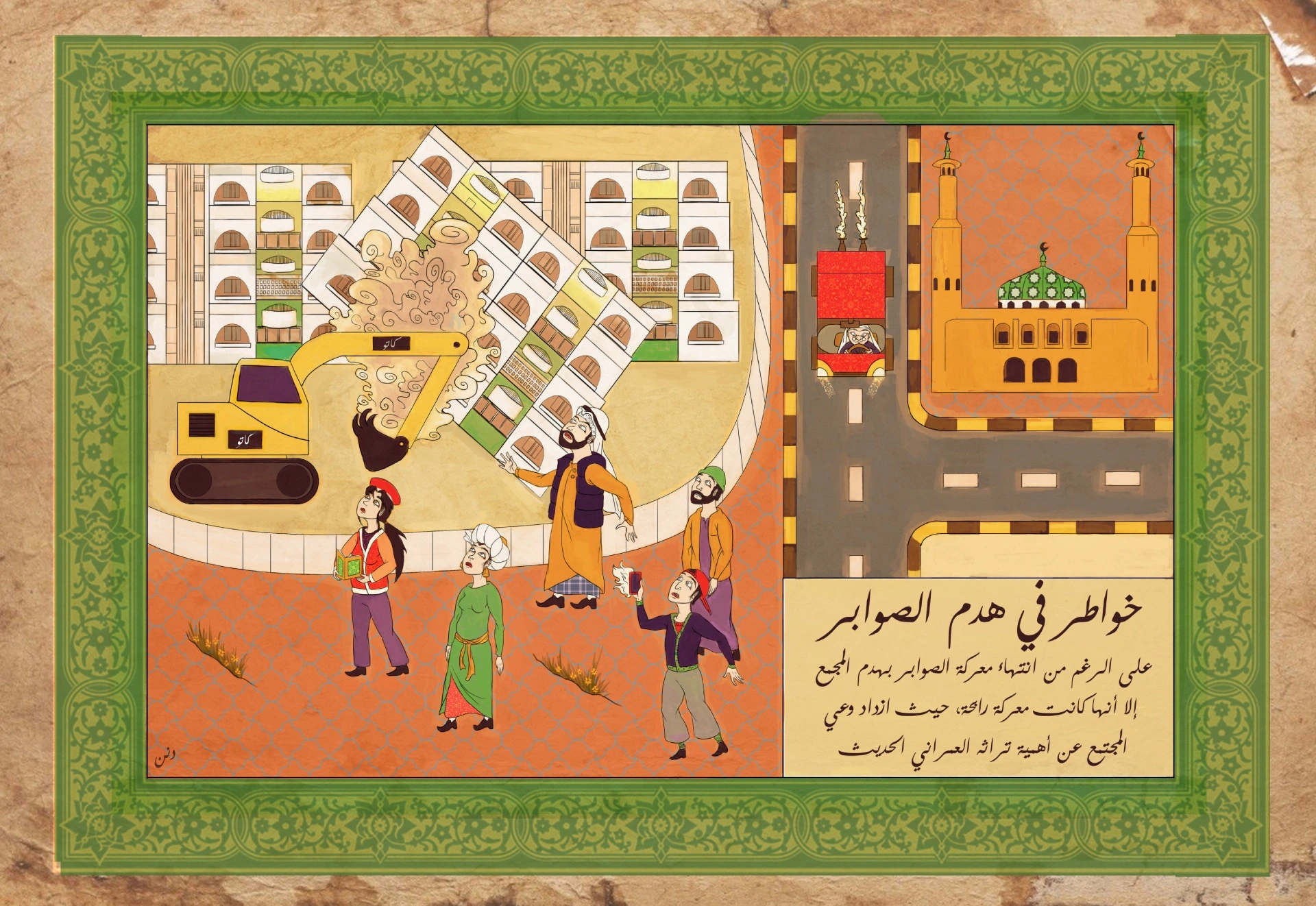
This work was the first of Al Rashid’s series of digital artworks that illustrate modern architectural heritage, and the systemic demolition of historical buildings in Kuwait. Here, viewers can observe the shock and disappointment of activists as they watch the demolition of the Al Sawaber Complex right in front of their eyes, despite their efforts to prevent such a cruel fate. However, the positive result of this occurrence is that it noticeably increased society’s awareness about the need to preserve historical buildings and modern heritage. The Al Sawaber Complex was built in 1979, and was designed by architect Arthur Ericson. It is considered to have been the first multi-story form of public housing in the country.
In keeping with the miniature style, the perspective is flat. Viewers will notice the contrast between the pale color of the reddened asphalt and the rich green color of the embellished frame. In addition, the emerging dust from the demolition of the complex is reminiscent of smoke clouds that appear as a result of an explosion, which emphasizes the level of shock that was experienced by the activists after the sudden event, especially after they left no stone unturned to save the building. They resorted to the courts and to the media to no avail. Also in this work is the Imam Al Sadiq Mosque (in the top right of the artwork), which witnessed bombings in 2015. It was incorporated by Al Rashid in this work to memorialize those who passed away, as well as a symbol of coexistence and appreciation of history.
Shaikha Fatima Mosque
Dana Al Rashid
2021
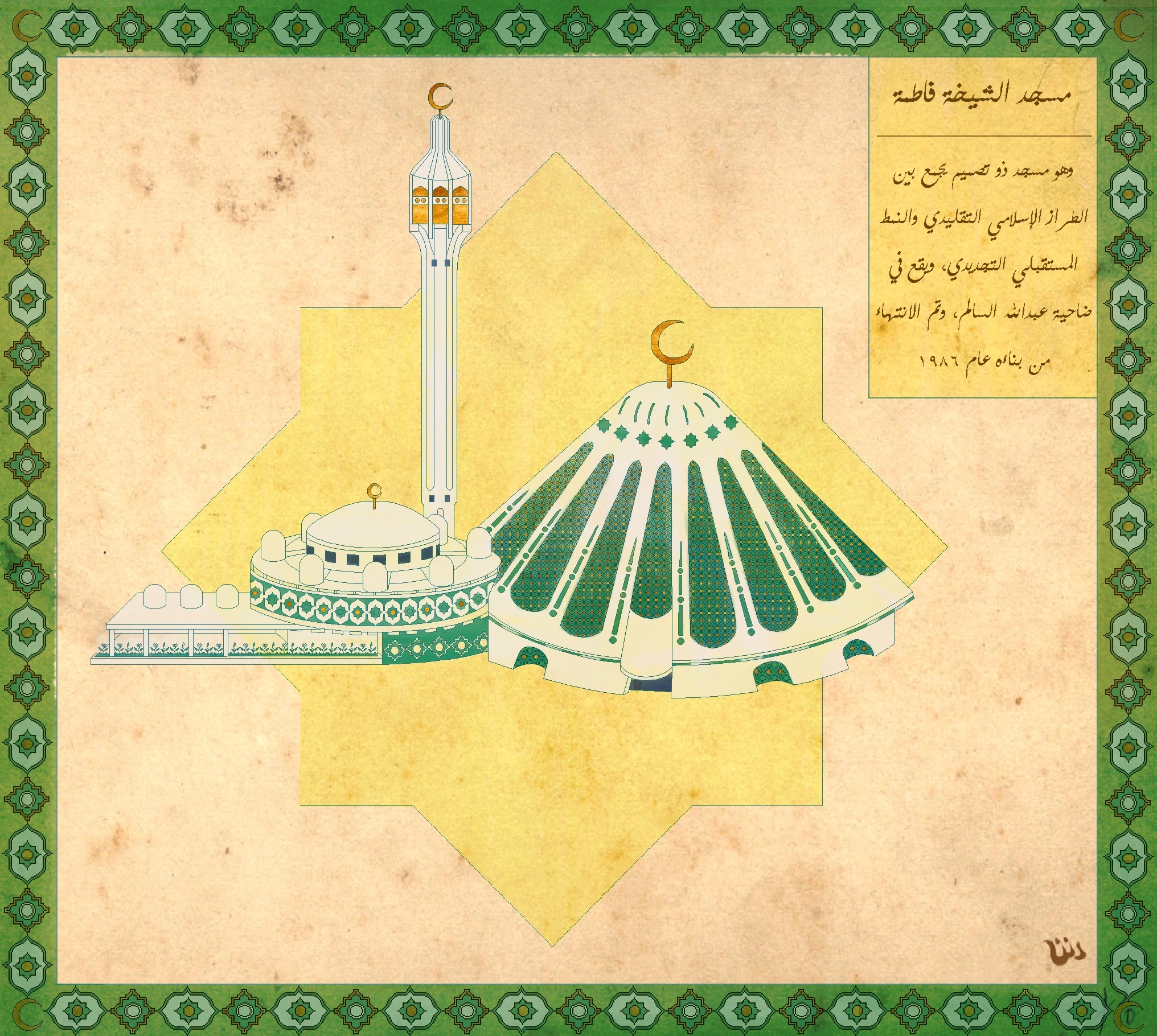
In Kuwait, there are many mosques with unique architectural designs, and fortunately, mosques are some of the most protected buildings and structures due to their religious sanctity. One of the most uniquely designed mosques is the Shaikha Fatima Mosque, which is located in the Abdullah Al Salem area, and which was constructed from 1979 to 1986. What makes the design of this mosque special are the conical dome and candlestick-like minarets, in addition to the existence of many side doors that prevent the crowding of worshippers as they enter and exit the mosque. The mosque is surrounded by a large garden with a geometric Islamic design. The shape of the garden was used by Al Rashid as the backdrop for the mosque in this work, and was filled in using a bright yellow color, resembling the sunrise. The design of the green frame was derived from the motifs of the mosque.
The mosque’s architectural style is a blend of traditional Islamic style and futuristic modern style, which has made it the perfect subject of Al Rashid’s modern digital miniature style of art.
The Last Skate
Dana Al Rashid
2021
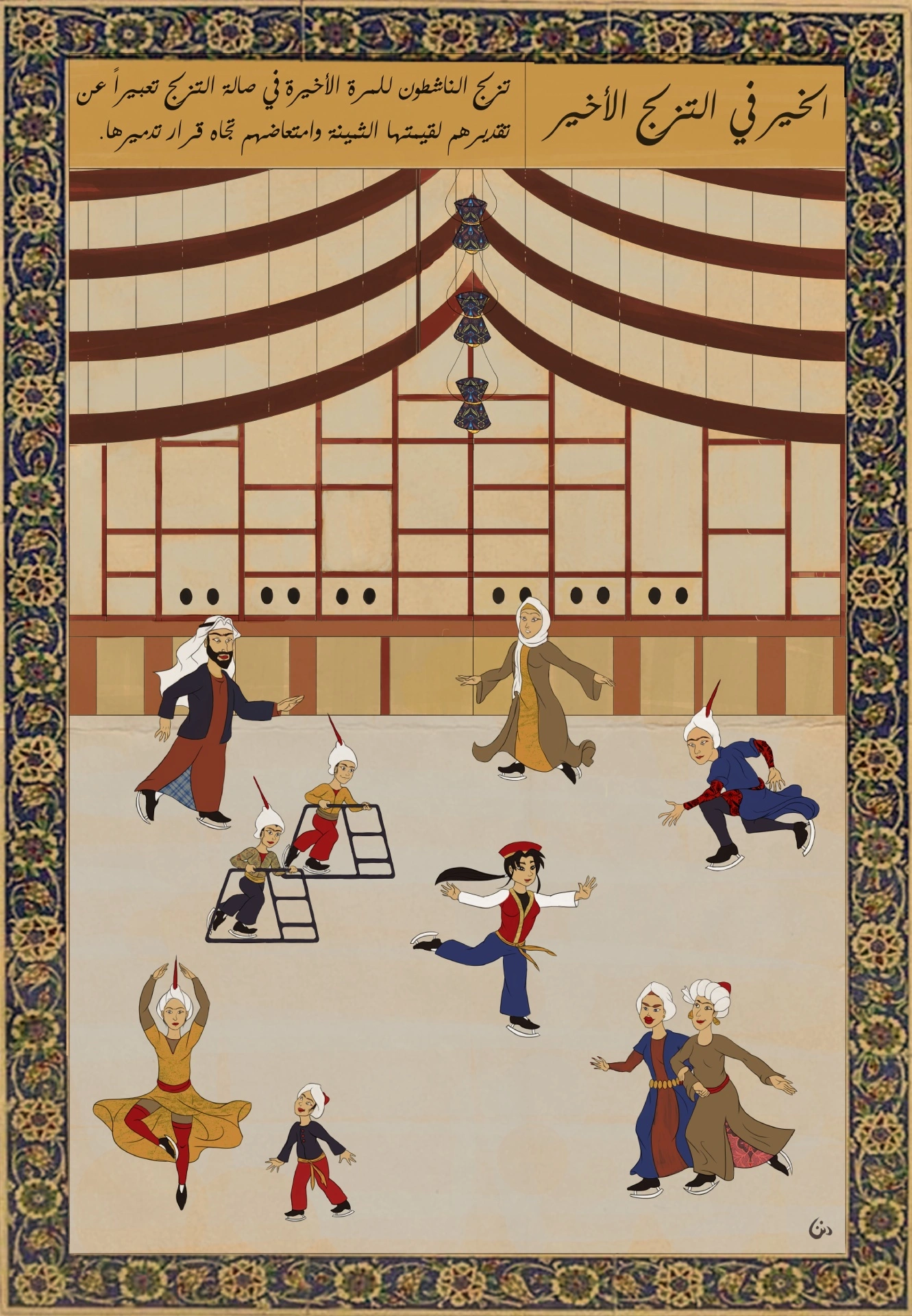
This work depicts activists skating one last time at the Kuwait Ice Skating Rink, which was the first of its kind in the Middle East when it opened to the public in 1980, and which was designed by French architect Dominique Beau. It is reminiscent of the Golden Age of Kuwait. Many Kuwaitis had precious memories there, but, unfortunately, it was demolished shortly after the “the last skate” in order to accommodate the third phase of development of the Al Shaheed Park.
Because of the flat perspective of the miniature style, Al Rashid was able to simultaneously document many architectural elements, such as the rink’s wooden ceiling, its entrance and exit doors, as well as the skaters. Merging reality with historical fantasy, the spotlights were replaced by lanterns, and contemporary characters were mixed with characters from ancient times, creating a rich and fascinating dialogue.
This work is the artist’s favorite, because she felt that all the elements were aligned in its making, from the color palette to the composition and subject matter. She considers it to be one of the most successful pieces from the series. The artwork was widely shared on social media, but a few days later, the Kuwait Skate Rink was abruptly demolished.
Justice at the Justice Palace
Dana Al Rashid
2021
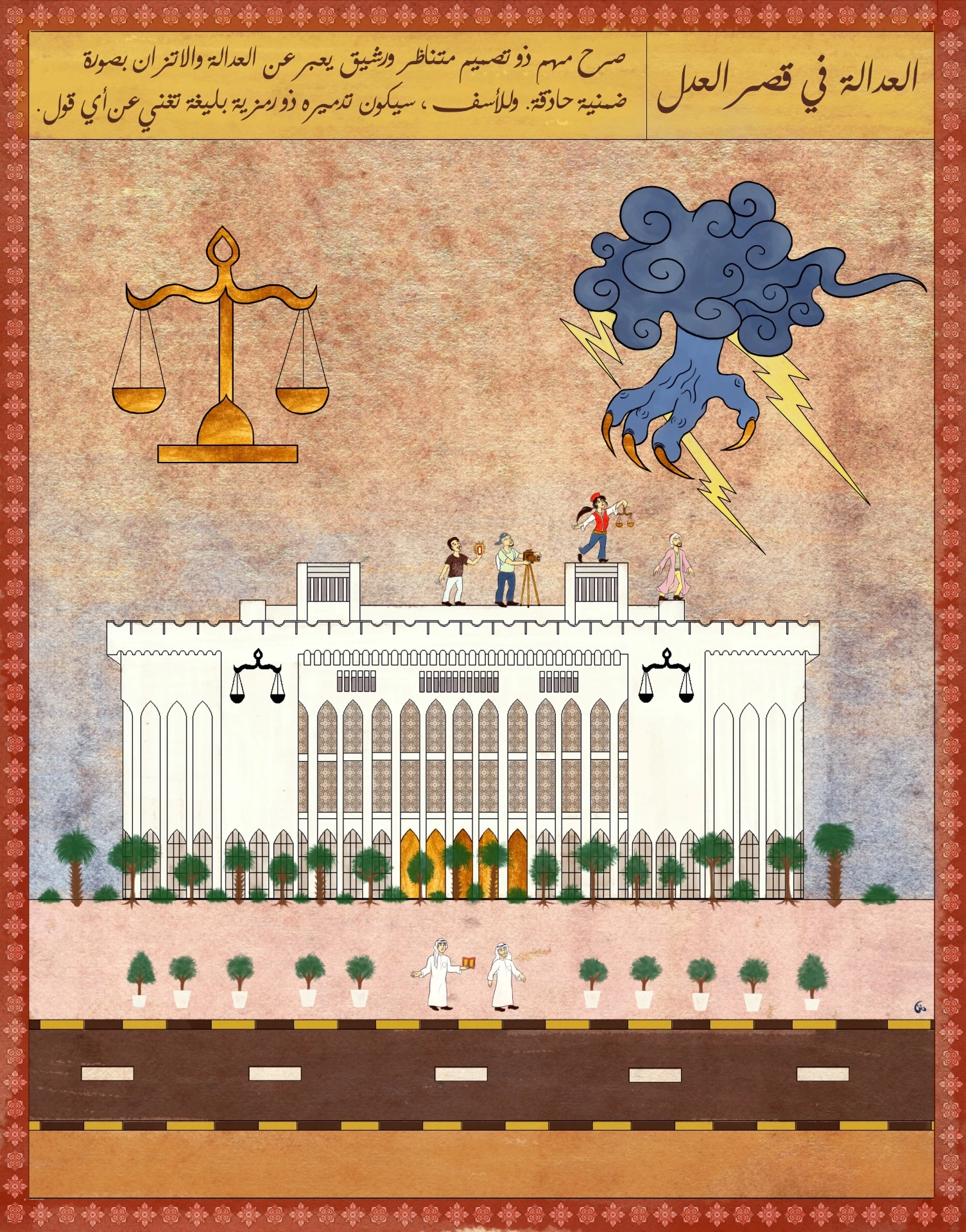
The Justice Palace is a remarkable architectural structure that is currently under the threat of demolition, as a newer concrete “palace” is now being built beside it. The Justice Palace was built in 1986 in a symmetrical style to reflect justice and balance, and therefore its demolition would be quite symbolic.
Here, activists, including lawyers, appear, representing the powers of good in a battle against invisible forces that call for the demolition of the building using weak arguments. The former are symbolized through the golden scale and the latter are symbolized through the monstrous blue hand reaching down from the sky, appearing from seemingly nowhere.
The personalities that are depicted in this work include: Dana Al Rashid (the artist behind the work), Abdul Raouf Murad (who is known for photographing historical buildings in Kuwait), Manahi Al Reesh (an architect and activist who calls for the preservation of structures such as this monument), and lawyers Shiryan Al Shiryan and Adnan Abul.
Al Hashemi II Miniature
Dana Al Rashid
2021
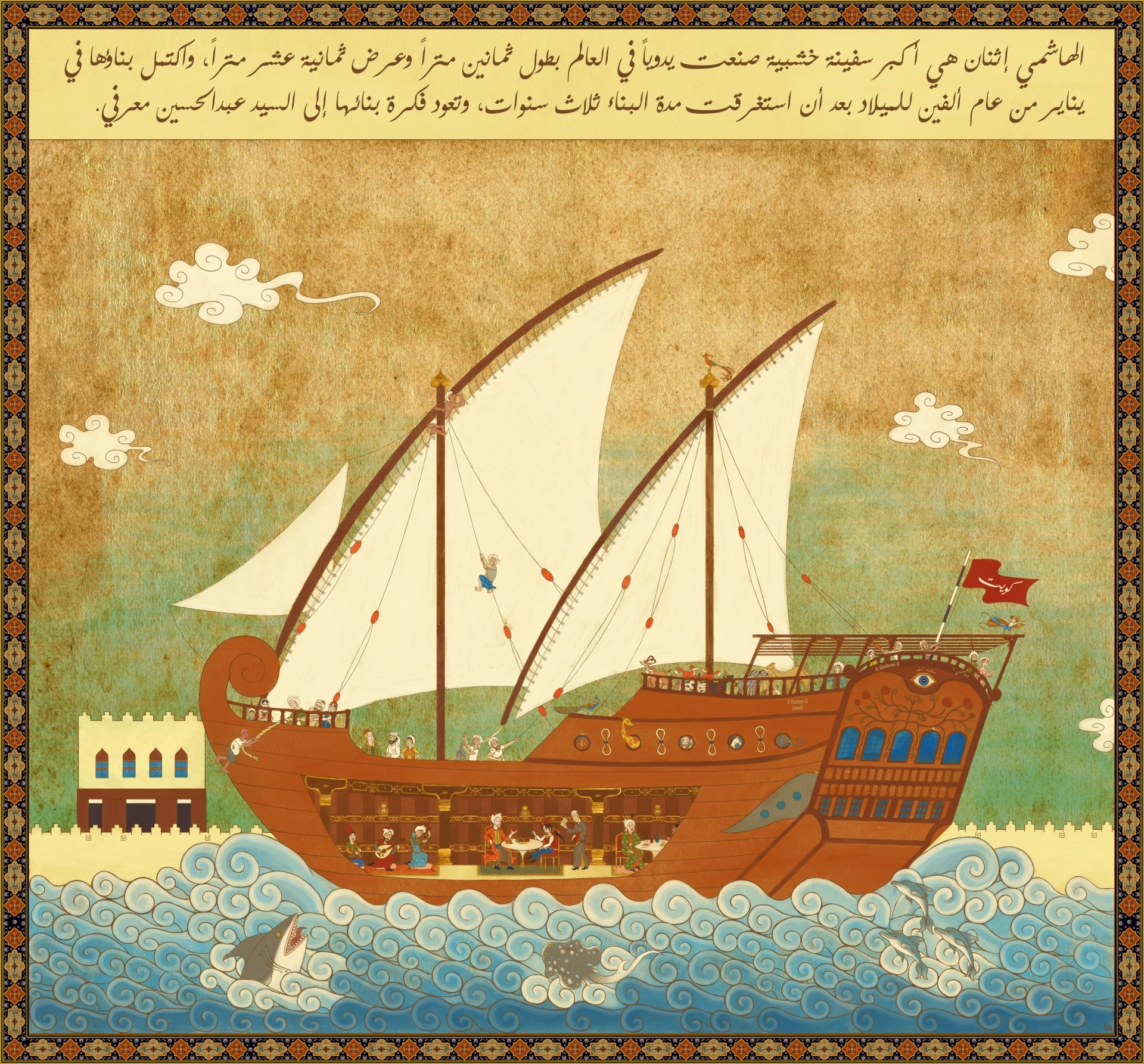
When construction on it was completed after three years in 2000, the Al Hashemi II Dhow was the biggest handmade dhow in the world, giving it its own unique place in the Guinness World Record.
The idea for the construction of the largest handmade ship was a dream of the late Abdulhusain Marafi, with the Marafi family funding the project. The ship was not intended for sail, and is permanently docked next to the Radisson Blu Hotel, with its vast spaces used as a restaurant, theatre and an event hall. Originally, the restaurant was located on the deck of the ship, but has been illustrated in the painting to be at the heart of the ship for aesthetic value.
The work incorporates elements of fantasy, as well as symbols from Islamic wisdom and spirituality, as is the regular practice in the traditional miniature format. Characters from all walks of life and backgrounds were included in this artwork, showcasing coexistence and equality, as well as reflecting the spirit of the hotel, which welcomes people from around the world.
The Healing of Kuwait Towers,
Dana Al Rashid
2021
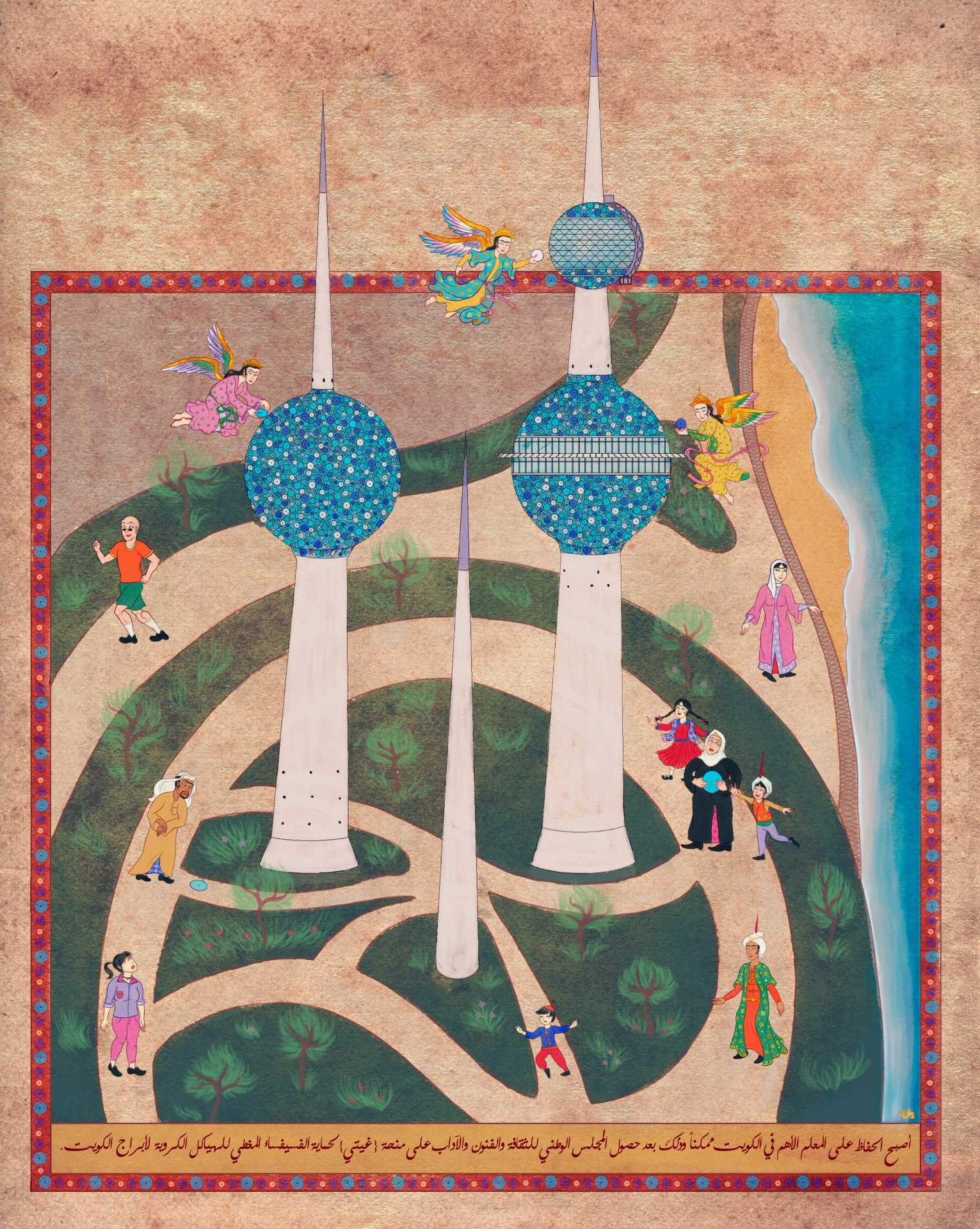
The Kuwait Towers are Kuwait’s most iconic structures. Officially opened to the public in 1979, the towers were designed by Danish architect Malene Bjørn. Their architectural design was inspired by Islamic domes and minarets, and the color choice of the mosaic-like steel disks was inspired by the Gulf’s blue hues and the Kuwaiti environment. The Kuwait Towers were designed in a modern style to align with the spirit of the times, reflecting Kuwait’s rapid progress. In 1980, the towers—as part of the larger Kuwait Water Towers system—were recognized with the prestigious Aga Khan Award for Architecture.
This work, which is a blend of reality and fantasy, celebrates Kuwait’s National Council for Culture, Arts and Letters’ receipt of the Getty Foundation grant, which will be dedicated to the maintenance of the towers’ disks, which have fallen off the towers in recent years. In the work, viewers can observe characters from all over the world examining the fallen disks in wonder, as well as angelic creatures “healing” the towers by putting the fallen disks back in place.